

Learn what makes ceramic mugs and saucers suitable for hot drinks, including body and glaze quality, lead and cadmium migration, and market-specific testing.
Introduction
Ceramic mugs and saucers are widely used in cafés, restaurants, hotels, offices and retail collections. Their appearance, heat retention and wide range of shapes and finishes make them suitable for many hot-beverage applications. For importers and wholesale buyers, however, the important question is not simply whether a product is made of ceramic. It is whether the finished article has been designed, manufactured and assessed for its intended food-contact use.
Are ceramic mugs and saucers and colored coffee mug safe for hot drinks? They can be, provided that the ceramic body, glaze and decorations are appropriate for the application and that the finished product meets the food-contact requirements of the destination market. Material names or a high firing temperature alone cannot establish this.

1. The ceramic body and firing process
Traditional ceramic tableware is made from inorganic mineral materials. Depending on the body, the formulation may include clay minerals, silica-bearing materials and fluxes. These ingredients help provide workability during forming and develop the required structure during firing.
Firing changes the body through a combination of physical and chemical processes. The resulting density, water absorption, strength and dimensional stability depend on the formulation and the complete firing schedule, including temperature, heating rate, atmosphere and time at temperature. Porcelain, stoneware, bone china and new bone china therefore should not be judged against one universal firing-temperature range.
A well-developed ceramic body supports the product's intended use, but it is not a substitute for food-contact assessment. A mug may have a dense body and still require migration testing of its glaze or decoration.
2. Why the glaze matters
A glaze is an inorganic surface coating that is fused to the ceramic body during firing. It can create a smooth, cleanable surface and contribute to the product's appearance, stain resistance and durability. The ceramic coffee mug glazes may be transparent, opaque, glossy, matte or coloured.
The glaze must be compatible with the body and matured under suitable firing conditions. Poor glaze-body fit or firing defects can contribute to problems such as crazing, pinholes, crawling or flaking. Those defects can affect product performance and may make cleaning more difficult.
A glossy surface is not proof of food safety. The glaze formulation, colourants, decorative materials, firing conditions and the migration behaviour of the finished article are all relevant. Decorations should be assessed according to their location and intended contact with food or the user's mouth.
3. Lead, cadmium and migration testing
Lead and cadmium are important substances considered in ceramic tableware compliance. The key question for food-contact assessment is whether a substance migrates from the finished article under the test conditions specified by the relevant market requirement.
In the United States, FDA Compliance Policy Guide Section 545.450 provides category-specific action-guidance levels for leachable lead from ceramicware. For cups and mugs, the guidance level is 0.5 micrograms per millilitre of leaching solution, applied to any one of six units in the described assessment. This is an FDA compliance action-guidance level; it should not be described as an FDA certification or as a universal limit for every ceramic product. [1]
In the European Union, Council Directive 84/500/EEC, as amended, sets lead and cadmium migration limits for ceramic articles. The applicable limit depends on the article category and the specified test conditions. The Directive also addresses testing and a declaration of compliance. Buyers should confirm the current requirements applicable to the product and market. [2]
International test methods, such as ISO 6486-1:2019, specify methods for determining the release of lead and cadmium from ceramic ware and certain glass dinnerware. The appropriate method and acceptance criteria must be selected for the target market. [3]
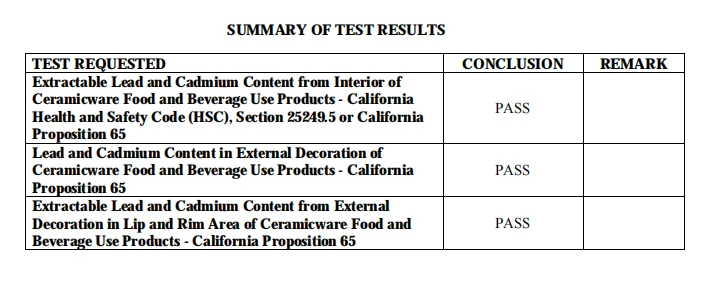
Below is one of our product test report for your ref:

4. What wholesale buyers should request
When sourcing ceramic mugs and saucers, buyers should ask suppliers to confirm:
- The ceramic body and glaze system used for the proposed product.
- Whether prints, decals, metallic details or other decorations are included in the test sample.
- Which destination market and regulatory requirements the test report covers.
- Whether the report identifies the tested product, model, material, colour or decoration clearly.
- Whether the production version will remain consistent with the tested sample.
A report for one plain white mug should not automatically be treated as evidence for every coloured, printed or differently glazed product in a collection. Changes to formulation, decoration or production can affect what needs to be assessed.
5. A manufacturing approach to product safety
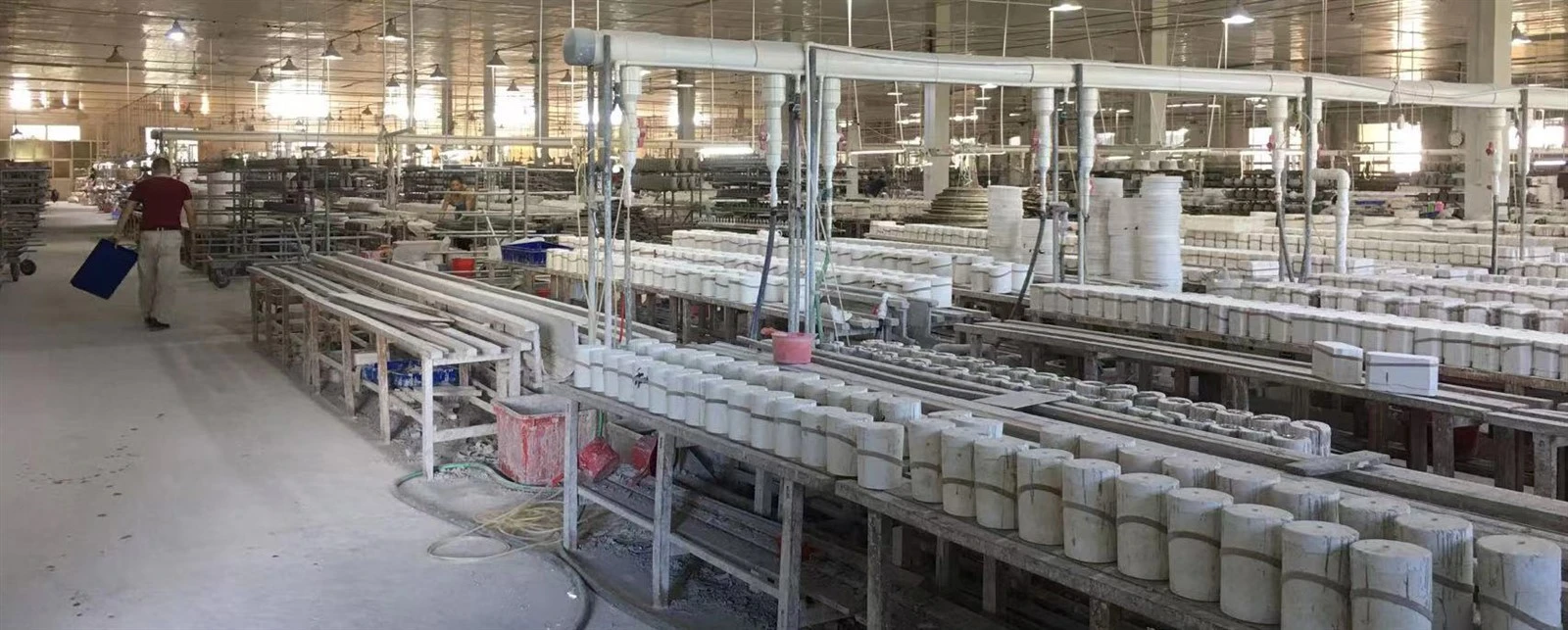
At Decocraft, our own-factory production covers porcelain, stoneware, bone china and new bone china. These materials have different formulations and processing characteristics, so product specifications and manufacturing controls need to reflect the selected body and finish. We have experience supplying different export markets and can discuss market-specific testing according to the customer's product and destination requirements.
For buyers, the most useful approach is to define the intended use and destination market before sample approval. This allows the product, decoration and testing plan to be considered together rather than treating compliance as a last-minute paperwork step.
Conclusion
Ceramic Coffee Cup With Saucer Set can be suitable for coffee, tea and other hot drinks when they are made with appropriate materials, controlled manufacturing processes and verified food-contact performance. Safety should be evaluated on the finished product, not inferred from appearance, a material label or firing temperature alone.
Sourcing ceramic mugs or cup-and-saucer sets for your business? Contact Decocraft Product Co. Ltd to discuss material options, product specifications, customization and the food-contact testing required for your target market.